
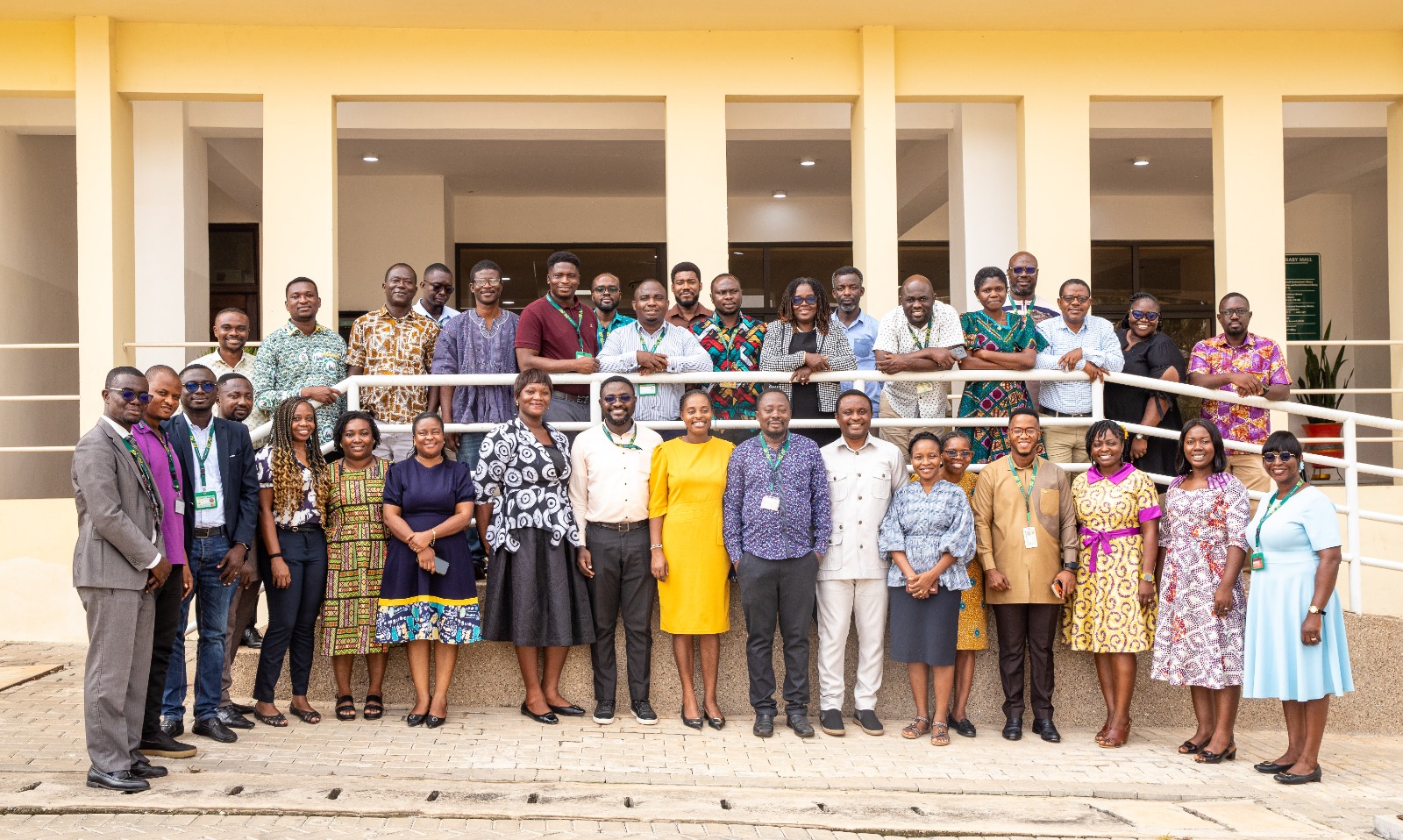
Selected faculty members from six colleges of the Kwame Nkrumah University of Science and Technology (KNUST), Kumasi have completed a four-day instructional design workshop organised by the KNUST E-Learning Centre.
The training, held from Tuesday, January 13 to Friday, January 16, 2026, was aimed at building staff capacity for online and blended teaching.
Participants were grouped into cohorts and taken through structured modules focusing on course design, learner support, assessment and digital delivery. Topics covered included online student success, multimedia tools for online facilitation, instructor presence, and the use of Moodle and Microsoft Teams for teaching.
Faculty members also toured the E-Learning Centre’s studios and facilities to understand how institutional support integrates with teaching and assessment processes.
Speaking at the closing session, Professor Samuel Asare-Nkansah, representing the Vice-Chancellor and Pro-Vice-Chancellor, said the University considers instructional design central to its academic direction.
“This training is important because teaching and learning is changing. Students learn in different ways, and staff need the skills to design courses that respond to those needs. Management appreciates your commitment and expects you to use these skills in your colleges,” he said.
Participants shared feedback during the final session, with some noting that the training helped them appreciate that online learners require different engagement methods from face-to-face teaching.
One participant said the workshop prompted a rethink of course planning. “I now see that online learning needs different techniques, especially to keep students engaged during assessments and activities,” the participant said.
Professor Nana Ewusi Mensah, Head of the Instructional Design Unit, said the workshop introduced participants to the foundations of instructional design and encouraged them to share knowledge within their departments.
“What we covered is only a part of the full instructional design process. The expectation is that participants become contact persons in their colleges and support others,” he said, adding that future phases of training would build on the skills introduced.
The Director of the KNUST E-Learning Centre, Professor Emmanuel Kofi Akowuah, said the University has invested in digital learning and expects staff to apply what they have learned.
“We want to see changes in how courses are designed and delivered. Practice is important. If there are challenges, support is available at the E-Learning Centre,” he said.
He added that the Centre plans to roll out shorter, targeted training sessions later in the year to deepen staff skills in specific areas of online teaching.


